

Incorporating aerodynamic, water catch, the effects of ice protection systems and more, AID is designed to provide a complete solution for aircraft icing design, helping you to plan and build your ideas in the most effective way. There are a significant number of modules to choose from depending on your design requirements. At AeroTex, our experienced team are always on hand to help you to identify which elements will benefit your project the most and to carry out whatever analysis you require.
Trajectory and Water Catch (TAC2)
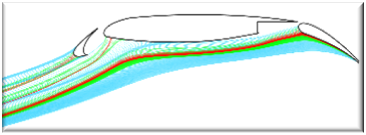
Prediction of water droplet trajectories and the resulting surface water collection efficiency on multi-element aerofoils (2D/2.5D).
The TAC2 code can be used to calculate the trajectory of cloud water droplets and resultant water droplet catch efficiency distribution on a multi-element 2D body in incompressible flow. This design software is the first step in the analysis procedure, guiding the user in where and in what quantity water will impinge on the components. This acts as a pre-curser to the calculation of ice accretion shape and size, and in the modelling of ice protection systems.
TAC2 is usually run in a mode where it calls IHB (see below) to calculate ice growth including the use of multi-stepping for when the shapes become too large.
Icing Heat Balance (IHB)
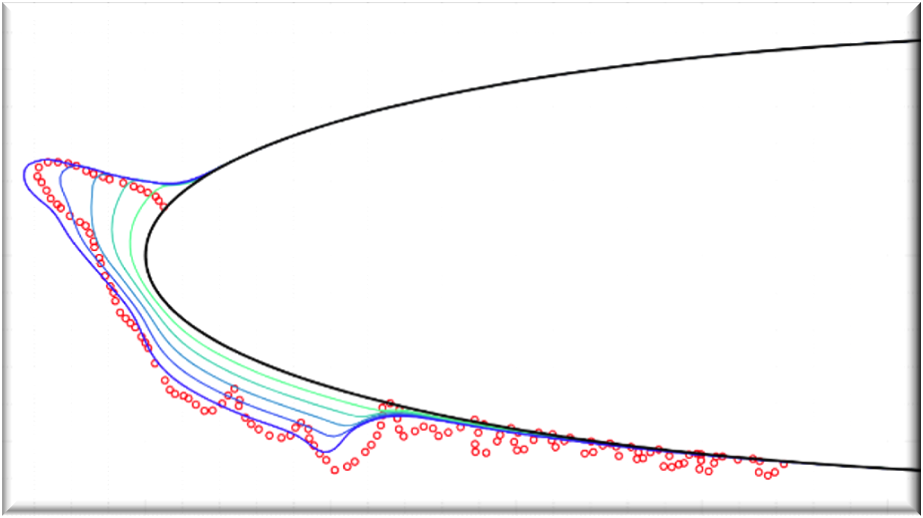
Calculation of ice growth rates on unheated or simplified thin-wall heated structure, to generate ice shapes and estimate power for thermal anti-ice systems (2D).
IHB (Icing Heat Balance) performs a steady-state thermal analysis on a heated, thin strip, structure in two-dimensions. The code performs a modified ‘Messinger’ type heat balance on the breeze surface, to calculate the local freezing fraction and surface temperature. The ice growth rates can be directly extrapolated to produce ice shapes, or automatically iterated with TAC2 to account for changes to aerodynamics and impingement as the ice grows. External heat may be specified at various chord wise locations to simulate the heat input from an ice protection system, and the code will calculate whether ice still grows, the surface runs wet, or the water is fully evaporated..
Hot-Air IPS (HAC)
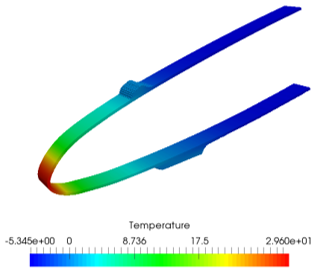
Prediction of thermal and icing response of a pneumatic (bleed-air) ice protection system (2D).
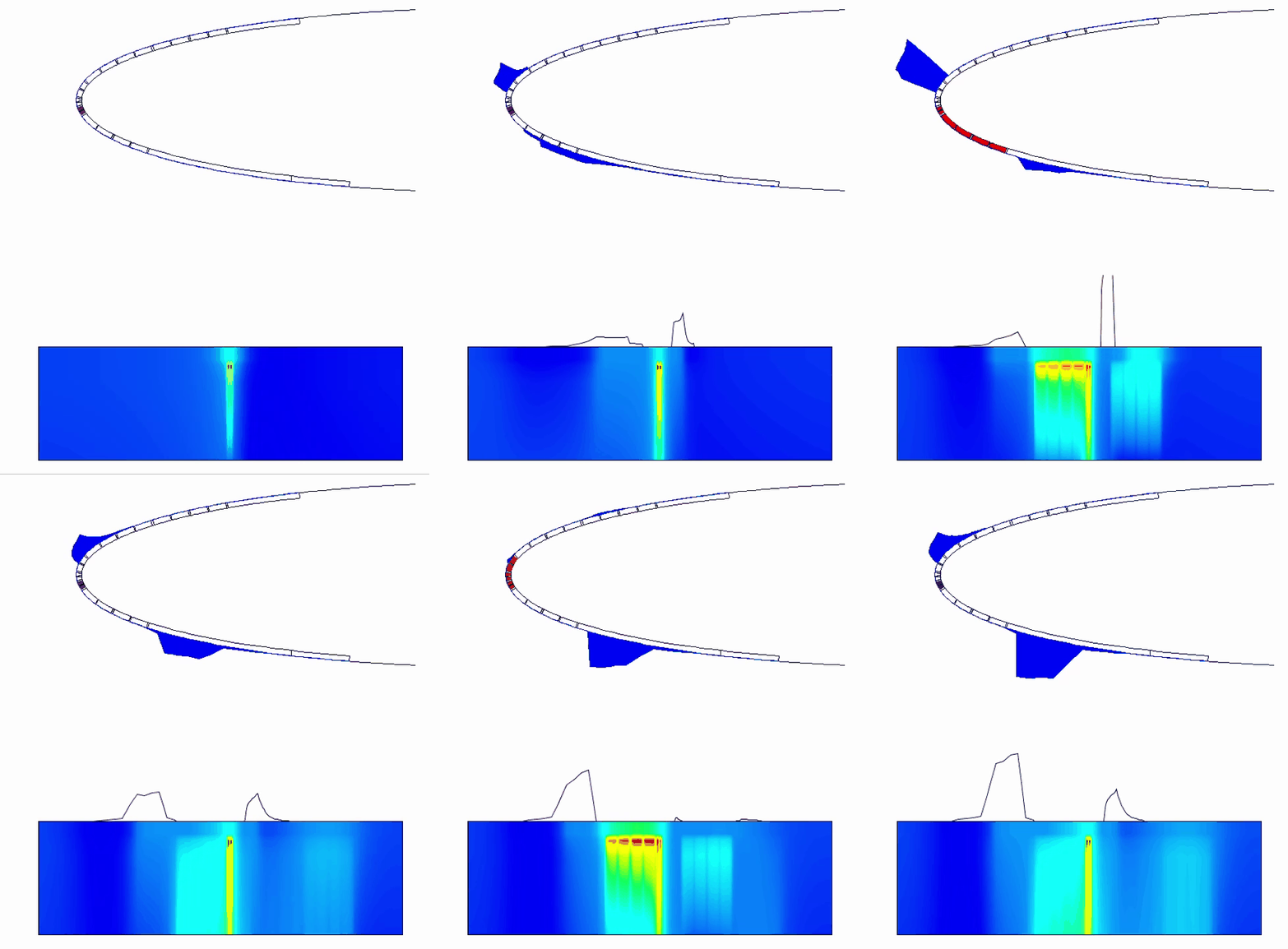
HAC, performs a steady-state thermal analysis on a 2D thin strip structure which is heated by air from an internally mounted piccolo tube arrangement. HAC models systems containing: piccolo tubes, double wall region, wall jet region, adiabatic flow region (no heat flow) and a plenum region (region of low flow, warm air).The code performs a heat balance on the breeze surface, to calculate the local freezing fraction and surface temperature whilst empirically derived heat transfer correlations are used to calculate the internal heat transfer coefficient distribution along with the internal heat flux distribution. The code will calculate whether ice will grow, the surface runs wet, or the water is fully evaporated, based on the freezing factor and impingement rate..
Electrothermal IPS (ET3D)
Prediction of thermal transients and icing response in a multi-layered structure with embedded heater elements (1D, 2D or 3D)
ET3D, performs a thermal transient analysis on a heated, multilayered, structure in three dimensions. The code is most commonly used in 2D for the design of systems and incorporates significant capabilities to model realistic ETIPS parameters.
–Heater scheduling
–Hysteresis type power modulation based on threshold temperatures
–Temperature measurement and response triggering for thermocouples and RTDs
–Power variation
–Ice and water film thickness variation with time, including the modelling of runback
–Shedding due to centrifugal effects (adhesive and cohesive)
–Specification of heat transfer coefficient for the modelling of complex 3D structures
–Zonal based power – constant heating intensity within a given zone
ET3D+ -Finite Element based analysis code
Prediction of thermal transients and icing response in a complex structure with embedded heater elements (2D)
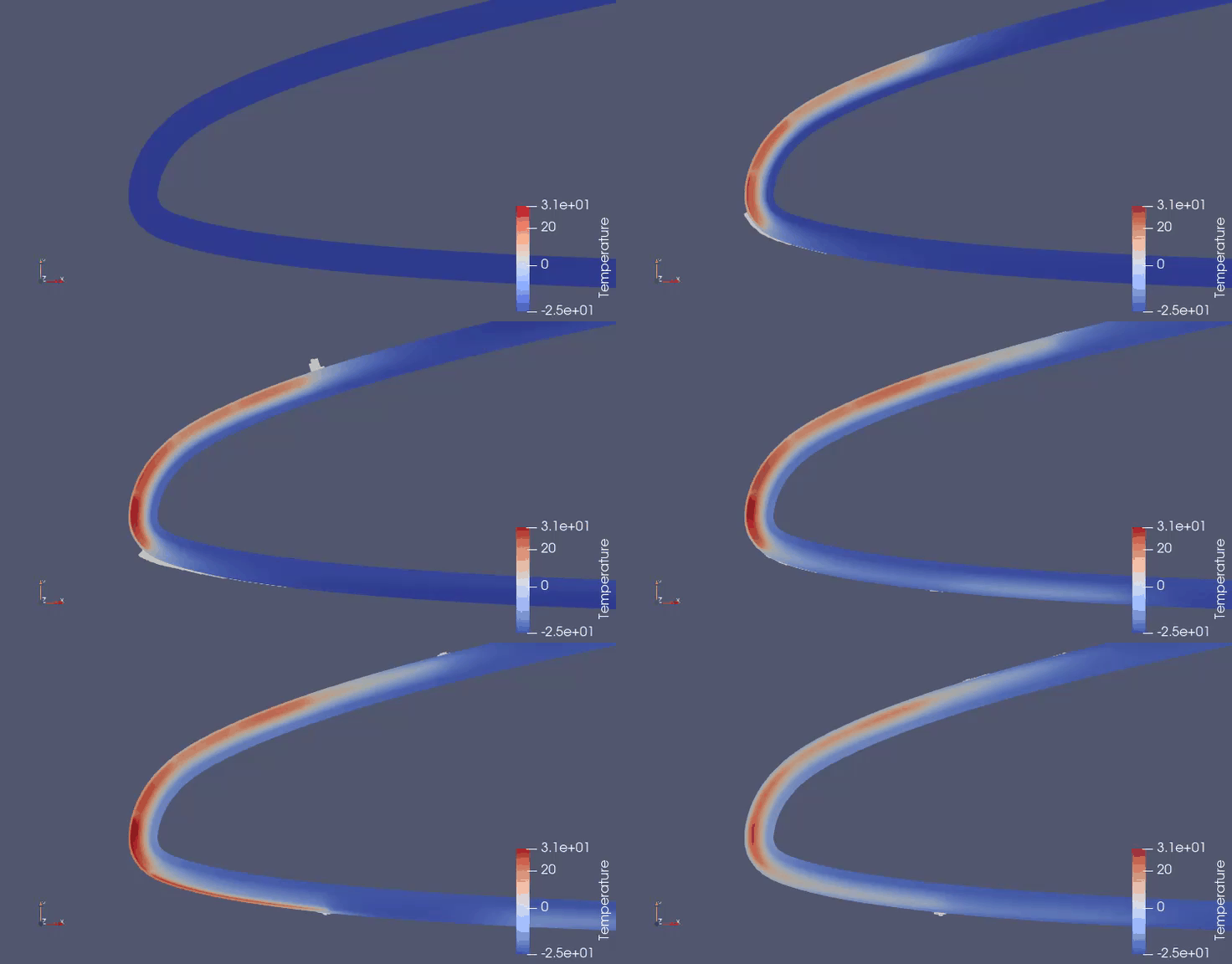
ET3D+ builds on the established legacy of ET3D to deliver the next generation of simulation capabilities for electrothermal ice protection systems. The finite element implementation enables the simulation of complex structures, allowing the impact of heatsinks such as spars to be included in the analysis. In addition, the finite element approach more accurately simulates tight radii heating effects.

HETEMS2D
A 2D analysis tools to simulate hybrid electrothermal-electromechanical ice protection systems
HETEMS2D incorporates many of the features of TAC2, IHB and ET3D within a single GUI based modelling environment. In addition, efficiently simulates the shedding from electromechanical or boots type ice protection systems, through either directly simulation of the force exerted by the system, or the displacement field generated by the ice protection system. Simplified stress based failure models are included, but this can be updated based on user requirements.
Droplet Residence Time (DRT)
For the assessment of residence time of droplets in an icing wind tunnel. This code provides advice on the suitability of specific wind tunnels for replicating specific test conditions.
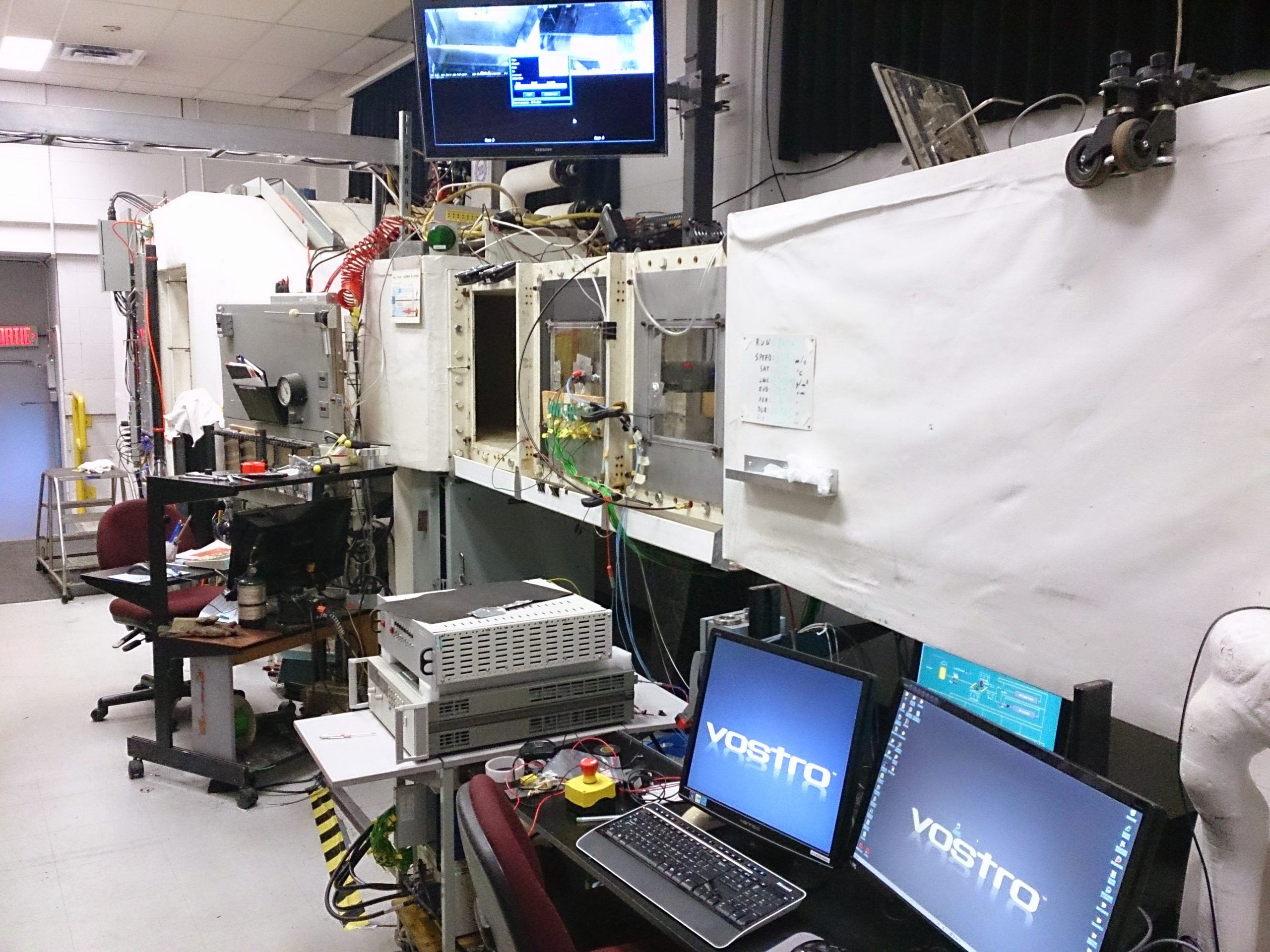
DRT is an analysis code to determine the residence time for droplets in an icing wind tunnel. The residence time is defined as the time (and hence distance) for a slow moving water droplet, injected into a fast moving air-stream, to achieve velocity and thermal equilibrium with its surroundings. This is important, since if they are not in equilibrium they will not act in the same way as they do in nature when they impact a surface.
The code is designed to be used to provide advice on the ability of an icing wind tunnel facility to accurately simulate Super-cooled Large Droplets (SLD) icing conditions, although it is also applicable to ‘classical’ icing conditions. The larger the droplets, the longer it takes them to reach equilibrium. Therefore, a tunnel which is well-suited to re-producing classical icing conditions may not be able to accurately reproduce the effects of SLD conditions, even if it is capable of producing droplets of the required size.
 using WordPress and